What Happens to a House When Someone Dies Without a Will in Indiana?
Indiana law decides who inherits it. The state has a set order, starting with the spouse and children, and the house usually still can't be sold until someone has clear authority to sign. How the deed was held matters first, because some houses never go through this at all.
Lesa Miller is a REALTOR® and broker in Bloomington, Indiana, who helps buyers and sellers in Bloomington, Bedford, Martinsville and the surrounding towns. Here's how it works, so you know what to ask the estate attorney.
Does the no-will order apply to every house?
No. Start with the deed. If the house was held with right of survivorship, had a transfer-on-death deed or was in a living trust, it may pass to that person or trust outside the no-will order. Does an Inherited House Go Through Probate in Indiana? walks through those.
The order below applies to a house that was in the person's name alone, with nothing else directing where it goes.
Who inherits the house if there's no will?
The shares in Indiana Code 29-1-2-1 apply to the net estate, which is roughly what's left after the estate's debts and costs.
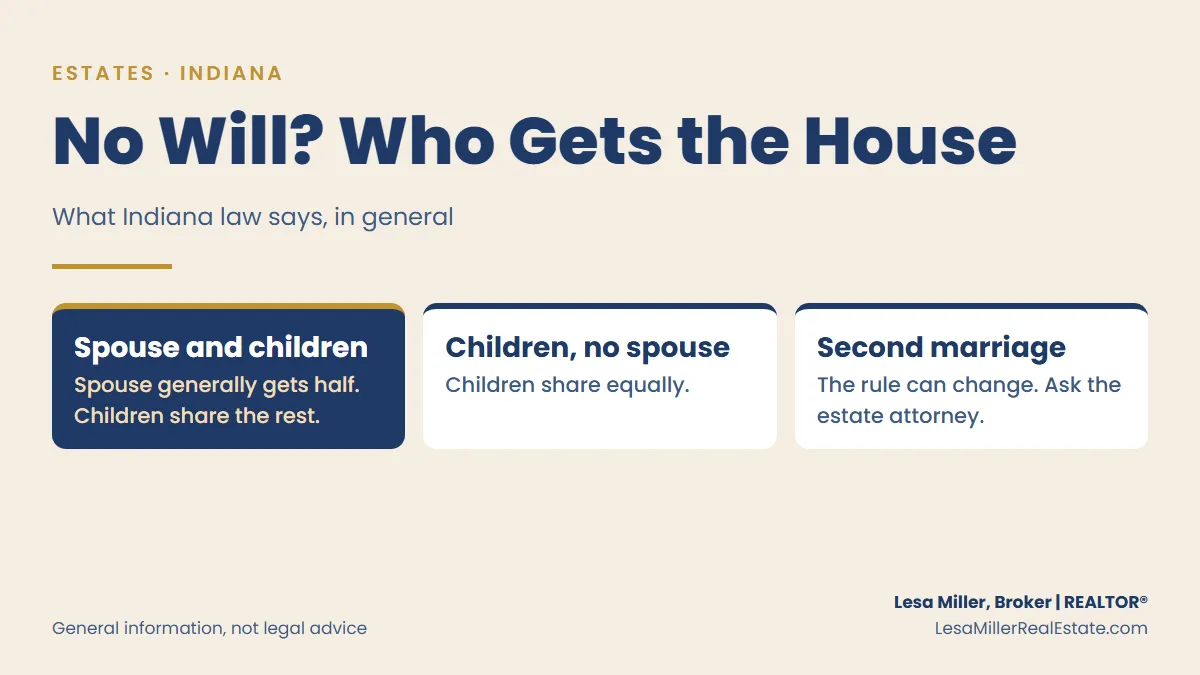
A spouse and at least one child: the spouse generally takes half, and the children share the other half.
A spouse, no children or grandchildren, and a living parent: the spouse takes three-fourths, and the parents take the rest.
A spouse, with no children, grandchildren or living parents: the spouse takes all of it.
Children and no spouse: the children share it equally. If a child has died, that child's children generally step into their share.
No spouse and no children: it goes to parents and to brothers and sisters. Each living parent gets at least one-fourth. If none of them survive, the law moves on to nieces and nephews, then grandparents, then aunts, uncles and their families.
Those are shares, so several people can end up owning one house together. That's often where the hard part starts.
What changes with a second marriage?
A lot. This is the rule most likely to surprise a family.
If the surviving spouse is a second or later spouse who never had children with the person who died, and that person left children, the spouse doesn't take half of the real estate. The spouse gets an amount equal to 25% of the real estate's value at the date of death, after liens and other debts on the property, and the children get the ownership.
If that's your family, talk with the estate attorney before anyone makes plans for the house.
Who can actually sell it?
Under Indiana Code 29-1-7-23, a person's property passes to their heirs at death, subject to the estate's debts and costs and to a personal representative's right to take possession. The deed on file still shows the name of the person who died, though, and a buyer's title company will want to see who has authority to sign.
There are two common paths:
Through probate. A court appoints a personal representative, who can then handle the sale. With no will, the spouse or the spouse's choice comes first, then an heir or an heir's choice. In Indiana, probate runs through the circuit or superior court in the county where the person lived. For someone who lived in Bedford, that's Lawrence County.
Without an open estate. Indiana law also allows an affidavit, recorded with the county, stating how the title passed to the heirs. The protection it gives a buyer generally doesn't start until at least seven months after the death. Each heir who owns a share typically has to sign the sale. Ask the estate attorney and the title company early whether this path fits your situation.
Indiana's small estate affidavit doesn't help here. It has a $100,000 limit, but the bigger issue is that it covers things like bank accounts and vehicles, not real estate.
The attorney handles the legal framework. Your real estate agent handles the sale. Both matter, and it's worth having that first conversation before you list. What Happens to a House When Someone Dies in Indiana? covers the probate side in Monroe and Lawrence counties.
What if the heirs don't agree?
Co-owners who can't agree still have options, and most families settle it without a courtroom. How Do You Sell an Inherited House When Siblings Disagree in Indiana? goes through what happens next.
Frequently asked questions
Who gets the house if someone dies without a will in Indiana?
It depends on who survives them. With a spouse and children, the spouse generally takes half of the net estate and the children share the other half. With children and no spouse, the children share equally. A second spouse who never had children with the person who died may take much less of the real estate.
Does a surviving spouse automatically get the house in Indiana?
Not always. If the deed gave the spouse survivorship rights, the house usually goes to the spouse. If it was in the other person's name alone, the state's shares apply, and children may own part of it.
Can you sell a house in Indiana if there's no will?
Yes, once it's clear who has authority to sign. That's usually a personal representative appointed by the court, or all the heirs who own a share. Ask the estate attorney and the title company which applies.
Does a house with no will have to go through probate in Indiana?
Not always. How the deed was held comes first, and Indiana also allows a recorded affidavit showing how title passed to the heirs. The estate attorney can tell you what your family's situation needs.
Settling a house with no will? Call or text (812) 360-3863, or visit LesaMillerRealEstate.com/Links.
This post is general information, not legal advice. Talk to your own attorney about your situation.