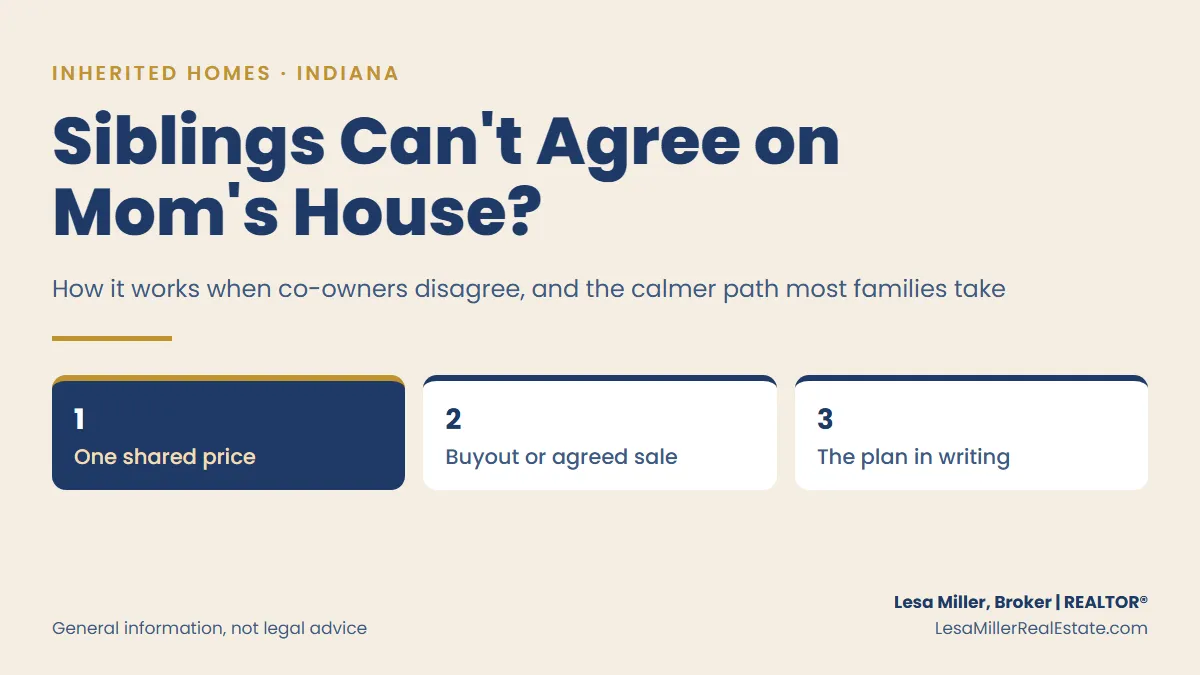
How Do You Sell an Inherited House When Siblings Disagree in Indiana?
When siblings inherit a house in Indiana and can't agree on what to do with it, there are three ways it usually goes. One sibling buys out the others. Everyone agrees to sell. Or someone asks the court to decide. Most families land on one of the first two, and they get there faster once everyone understands what the third option actually looks like.
I've sat at a lot of kitchen tables in Bloomington where the house was the last thing Mom or Dad left, and the hardest part wasn't the paperwork. It was three people with three different ideas about the same house. Here is how that actually works.
Why do siblings end up disagreeing about an inherited house?
It's rarely about the money alone. One sibling lives nearby and wants to keep the house in the family. Another lives out of state and needs the cash. A third has been paying the taxes and the electric bill and feels that should count for something. Everyone is grieving at the same time.
None of that is unusual. It just means the decision needs a clear process, not more arguing.
Who actually controls the house?
That depends on how the title passed and whether there's an open estate. If the house is going through probate, the personal representative usually handles the sale. In a supervised estate, the court approves the sale. In an unsupervised estate, which is common in Indiana, the personal representative can usually sell without a court order. If the house has already passed to the siblings as co-owners, each one owns a share, and a sale typically needs everyone's signature.
That's a question for your estate attorney, and it's worth asking first, because it changes who signs and how long it takes. My earlier post, Does an Inherited House Go Through Probate in Indiana?, walks through the basics.
What happens if one sibling won't sell?
Indiana law lets a co-owner ask the court to divide the property, called a partition action (Indiana Code 32-17-4-1). For a single house, dividing it isn't practical, so these cases usually end in a sale.
Here's the general shape of the process under Indiana Code 32-17-4-2.5:
The court refers the case to mediation, normally within 45 days after all the owners are part of the case.
A licensed appraiser values the property, unless the owners agree to skip the appraisal.
The owners get 60 days to reach an agreement. If they can't, the court orders the property sold.
The sale can go through an auctioneer or a sheriff's sale, unless all the owners agree to sell through a real estate professional at an agreed price.
After costs, the proceeds are split by each person's ownership share. A sibling who buys the property gets credit for the share they already own.
Your attorney will tell you how this applies to your family. What I'd point out from my side is the cost: legal fees, months of waiting, and often a lower price than the house would bring on the open market.
What's the calmer path most families take?
Most families never get near a courtroom. Here's what I've seen work:
Get one shared number. A market analysis or an appraisal everyone sees at the same time. Most disagreements shrink once the number is on the table.
Price out a buyout. If one sibling wants the house, the others' shares can be bought out at that shared number, often with help from a lender.
Agree on the basics before listing. Who handles repairs, who pays the bills until closing, and how the money is split. Put it in writing with your attorney.
Pick one point of contact. One sibling, or the personal representative, talks to the agent. Everyone gets the same updates.
Drama doesn't help anyone reach the closing table. Clarity does. For what to expect once the house is on the market, see Selling an Inherited Home in Bloomington, Indiana: What to Expect.
Where does a real estate agent fit in?
The attorney handles the legal framework. Your real estate agent handles the sale. Those are two separate roles, and both matter. On my side, that means a fair price everyone can see the reasoning behind, a plan for an empty or full house, and steady updates so no one feels left out. For the whole probate picture in Monroe and Lawrence Counties, see What Happens to a House When Someone Dies in Indiana?
Frequently asked questions
Can one sibling force the sale of an inherited house in Indiana?
A co-owner can ask the court to partition the property under Indiana Code 32-17-4. For a single house, that usually ends in a court-ordered sale if the owners can't agree after mediation. Talk to an estate attorney about your situation.
Can one sibling buy out the others?
Yes. A buyout at an agreed value is one of the most common ways families settle it. In a partition case, a sibling who buys the property gets credit for the share they already own (Indiana Code 32-17-4-2.5).
How long does a partition case take in Indiana?
It varies by county and by family. The process includes mediation and, in most cases, an appraisal, and owners have 60 days to reach an agreement before the court orders a sale. An agreement outside court is almost always faster.
Not sure where to start? Call or text (812) 360-3863, or visit LesaMillerRealEstate.com/Links. Nothing has to happen this week.
This post is general information, not legal or tax advice. Talk to a licensed Indiana attorney about your family's situation.