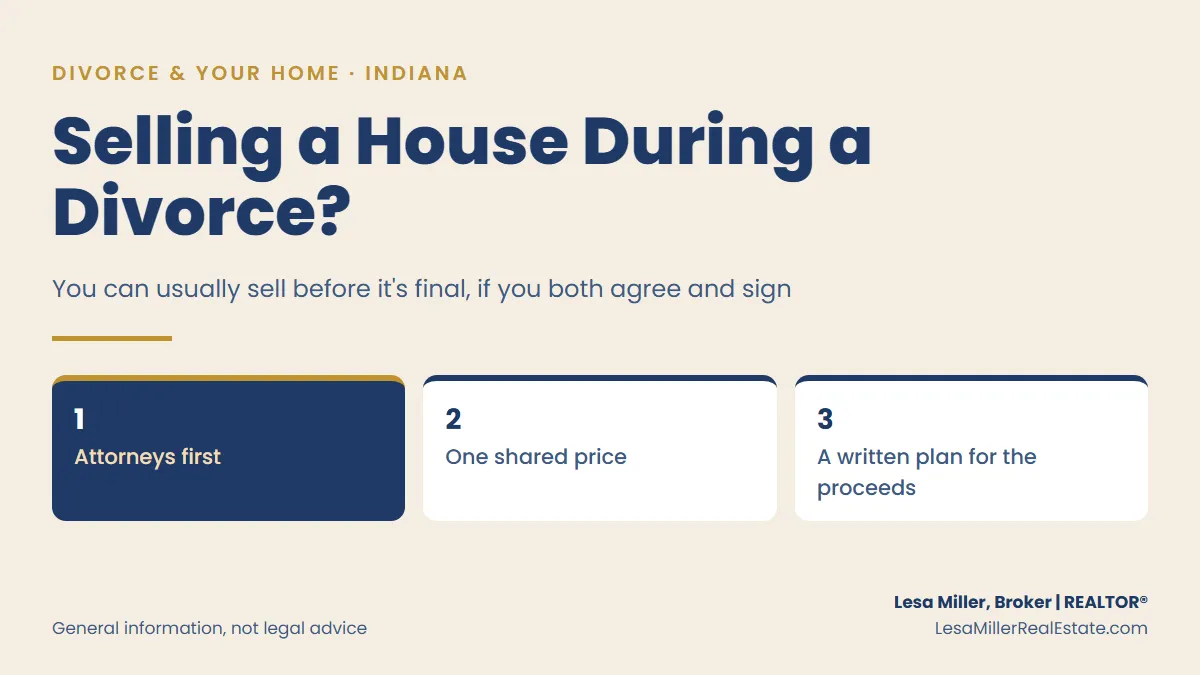
Can You Sell Your House Before Your Divorce Is Final in Indiana?
Usually, yes. In Indiana you can sell the marital home before the divorce is final if both spouses agree to the sale and everyone on the title signs. Without both spouses' agreement, a judge generally can't order it sold before the final decree. In 2022, the Indiana Court of Appeals ruled that temporary orders during a divorce can decide who lives in the house, but not order it sold over a spouse's objection. So an early sale works best as a decision the two of you make together, with your attorneys.
Lesa Miller is a REALTOR® and broker in Bloomington, Indiana, who helps homeowners sell during divorce, probate and other life changes. Here is how that actually works.
How long does an Indiana divorce take?
There is a minimum 60-day waiting period after the petition is filed before the court can finalize a divorce in Indiana. Many cases take longer, especially when there's property to divide. A house sale can take 30 to 60 days or more from listing to closing, so many couples start talking about the house early instead of waiting for the final decree.
Can one spouse sell the house without the other?
Not if both names are on the title. A buyer's title company will need signatures from every owner. Even when only one spouse is on the title, the house is often still part of what the court divides, and selling it without agreement can create serious problems in the divorce. That's a question for your family law attorney before anyone signs a listing agreement.
Indiana doesn't automatically freeze property when a divorce is filed. Either spouse can ask the court for an order that keeps property from being sold or transferred while the case is pending (Indiana Code 31-15-4). Your attorney can tell you whether one is in place in your case.
What can the court order about the house before the divorce is final?
During the case, a judge can issue temporary orders, including who stays in the house. In Rambo v. Rambo (2022), the Indiana Court of Appeals said the temporary-order statute allows "an order for the possession of property, not the sale." A court can order a sale as part of the final property division. Before that, a temporary order to sell generally takes both spouses' agreement.
In practice, that means if you both want to sell now, you can agree to it. If one of you doesn't, the house usually waits for the final decree or a settlement.
What are the steps to sell during a divorce?
Here's the order I'd follow:
Talk to your attorneys first. Confirm there's no order restricting a sale, and agree in writing on the plan.
Agree on who decides what. Price, repairs, which offers to accept, and who handles showings. Write it down.
Get one shared number. A market analysis both of you see at the same time takes the guesswork out of the price. My post How to Price Your Home Correctly in Bloomington, Indiana explains how pricing works.
Decide what happens to the money. Many couples agree to hold the sale proceeds until their settlement says how to split them. Your attorneys and the title company set that up.
Pick one way to communicate. Some couples want every update sent to both of them at the same time, in writing. That keeps everyone on the same page.
Get the house ready to show. If one spouse still lives there, agree on showing times and who keeps it ready.
Plan the move. If someone needs a little more time after closing, a rent-back can help. See Rent-Back Agreements: How Sellers Can Stay in Their Home After Closing.
What mistakes cost couples the most?
Listing before the attorneys agree. It can stall the sale or create problems in the case.
Pricing for the settlement instead of the market. Buyers pay what the market supports, not what one spouse hopes to walk away with.
Two sets of instructions. When each spouse tells the agent something different, offers sit and buyers walk.
Letting the house slide. A home that isn't kept show-ready sells for less and takes longer.
Waiting to talk about the money. Decide how proceeds will be held before closing day, not at the closing table.
What does this look like in real life?
Here are a few common situations, described generally:
Both agree to sell now. They get one shared price, sign the listing together, and agree the proceeds stay with the title company or in an attorney's trust account until the settlement is signed.
One spouse wants to keep the house. The other spouse's share is usually bought out instead of selling, often through a refinance. A market analysis helps both sides start from the same number.
One spouse is still living there. They agree on a showing schedule, and the spouse who moved out gets updates in writing at the same time.
For the bigger picture, my earlier post What Divorce Means for Your Home in Indiana walks through the options.
What if one spouse wants to keep the house?
Then the question becomes a buyout instead of a sale. The spouse who keeps the house typically pays the other for their share of the equity, and often refinances the mortgage into their own name. Two things drive that conversation:
A fair value. A market analysis or an appraisal gives both of you the same starting number. Arguing from two different numbers is where buyouts stall.
Whether the refinance works. The spouse keeping the house has to qualify for the new loan on their own income. Talk to a lender early, before the settlement is signed, so the plan is one that can actually close.
How the equity is split and how the deed changes are decisions for your attorneys. My part is helping you understand what the house is worth in today's market.
Can you buy a new home before your divorce is final?
It's possible, but it's harder. Lenders look at your whole financial picture, and a pending divorce can change it: shared debts, support payments and the money you'll receive from the house may not be settled yet. Many lenders want to see the signed settlement or final decree before they approve a new loan.
If you need a place to live sooner, renting for a short time or a rent-back on the house you're selling can bridge the gap. Talk to a lender about your timing, and to your attorney before you sign anything for a new home. When your current home has sold, I'm glad to help you with the process of finding the next one.
Where does a real estate agent fit in?
The attorneys handle the divorce. Your real estate agent handles the sale. Those are separate roles, and both matter. On my side, that means a price both of you can see the reasoning behind, a steady process, and equal, written updates so neither of you is left out. I have completed Certified Divorce Real Estate Expert training, and I keep the conversation focused on the house, not the divorce.
Lesa Miller is a REALTOR® and broker in Bloomington, Indiana, who helps homeowners sell during divorce, probate and other life changes. Drama doesn't help anyone reach the closing table. Clarity does.
Frequently asked questions
Can you sell a house before a divorce is final in Indiana?
Usually, yes, if both spouses agree and everyone on the title signs. Talk to your family law attorney first to make sure no court order restricts a sale.
Can a judge make us sell the house before the divorce is final?
Not without both spouses' agreement, generally. In 2022 the Indiana Court of Appeals held that temporary orders can decide who possesses the house, not order its sale over a spouse's objection. A sale can be ordered as part of the final property division.
What happens to the money from the sale?
Many couples agree to hold the proceeds with the title company or in an attorney's trust account until the settlement says how to divide them. Your attorneys set that up.
Can one spouse buy out the other instead of selling?
Yes. The spouse keeping the house usually pays the other for their share of the equity and often refinances the mortgage into their own name. A shared value and an early talk with a lender make it easier.
Can I buy a new house before my divorce is final?
It's possible but harder. Many lenders want the signed settlement or final decree first. Talk to a lender about timing and to your attorney before signing anything.
How long does a divorce take in Indiana?
At least 60 days from filing, and often longer when there's property to divide.
Not sure where to start? Call or text (812) 360-3863, or visit LesaMillerRealEstate.com/Links. Nothing has to happen this week.
This post is general information, not legal advice. Talk to a licensed Indiana family law attorney about your situation.